Cabonne Council,Castlereagh Macquarie County Council,Central Tablelands Weeds Authority,Cootamundra Shire Council,Dubbo Regional Council,Lachlan Shire Council,Mid-Western Regional Council,Orange City Council,Wellington
Landholder Responsibilities:
The growth of the plant must be managed in a manner that reduces its numbers spread and incidence and continuously inhibits its reproduction.
Why Is It Bad?:
Often planted in gardens as an ornamental, pampas grass can become weedy especially in urban areas and bushland on the central coast and central tablelands of NSW. It is not considered a threat to agriculture as seedlings do not survive grazing or cropping.
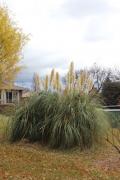
Pampas grass forms large tussocks to 3m (6m when in flower) and can spread by seed or vegetatively through spread of rhizomes. It will thrive in infertile soils and tolerates frost and water-logging. Established plants are a fire hazard, harbour vermin and displace native vegetation.
Identification
Habit:
Grass
Leaves:
Leaves are rough to touch, up to 2m long, arching down to the ground.
Flowers:
Flowers occur on tall flowering stems that reach to 6m. Flowers are large, fluffy, 30-90cm and have a silky feel. They can be pink, mauve or white/cream.
Fruit:
A single seed head can produce 100000 seeds which are wind dispersed.
Roots:
Roots can extend 3.5m deep and 4m wide.
Control Methods
Manual Removal:
Smaller plants can be hand pulled. Larger plants can be slashed first to make removal of crown and roots easier. Any seed heads should be collected and destroyed.
Chemical Use:
Foliar spray or wiper applicator can be used, ensuring plant is not stressed by drought or frost. Please refer to the Noxious & Environmental Weed Control Handbook or your friendly local weeds officer for more information. Integrated weed management is recommended for successful control.
Fire:
Slashing & Cutting:
Remove flowering heads before seed set to prevent spread via seeds. Wind can disperse seeds up to 25km.
Biological Control:
Grazing:
Seedlings do not survive grazing.
Cultivation & Scalping:
Seedlings do not survive cropping.
Smothering:
Solarisation:
Competition:
Monitoring:
Successful treatment programs rely on ongoing monitoring of sites. Regrowth and new seedlings can easily become larger infestations if follow-up treatments are not part of the management program.